
Our winning competition proposal for the Bastrop Arts and Culture Walk will move forward into a park design master plan. Our concept design weaves together the cultural and natural history of the Bastrop community. Now, the work will be further developed into a park master plan in collaboration with Burditt Land Consultants. Our task is to...
Falon Mihalic's interview with Peter Walker published in CITE 99

Table of Contents of Cite 99. Photo by Peter Mollick. Published by Rice Design Alliance
Falon Mihalic had the honor of interviewing one of the most revered landscape architects, Pater Walker, about the work of James Burnett and the role of Landscape Architecture today. The article is published in the current issue of Cite 99: Synthetic Nature by the Rice Design Alliance.
Falon Land Studio Awarded Best of Houzz 2017
Falon Land Studio LLC has won “Best Of Customer Service” on Houzz®, the leading platform for home remodeling and design. The innovative public art and garden design firm was chosen by the more than 40 million monthly unique users that comprise the Houzz community from among more than one million active home building, remodeling and design industry professionals.
A Biophilia Inspired Reading List
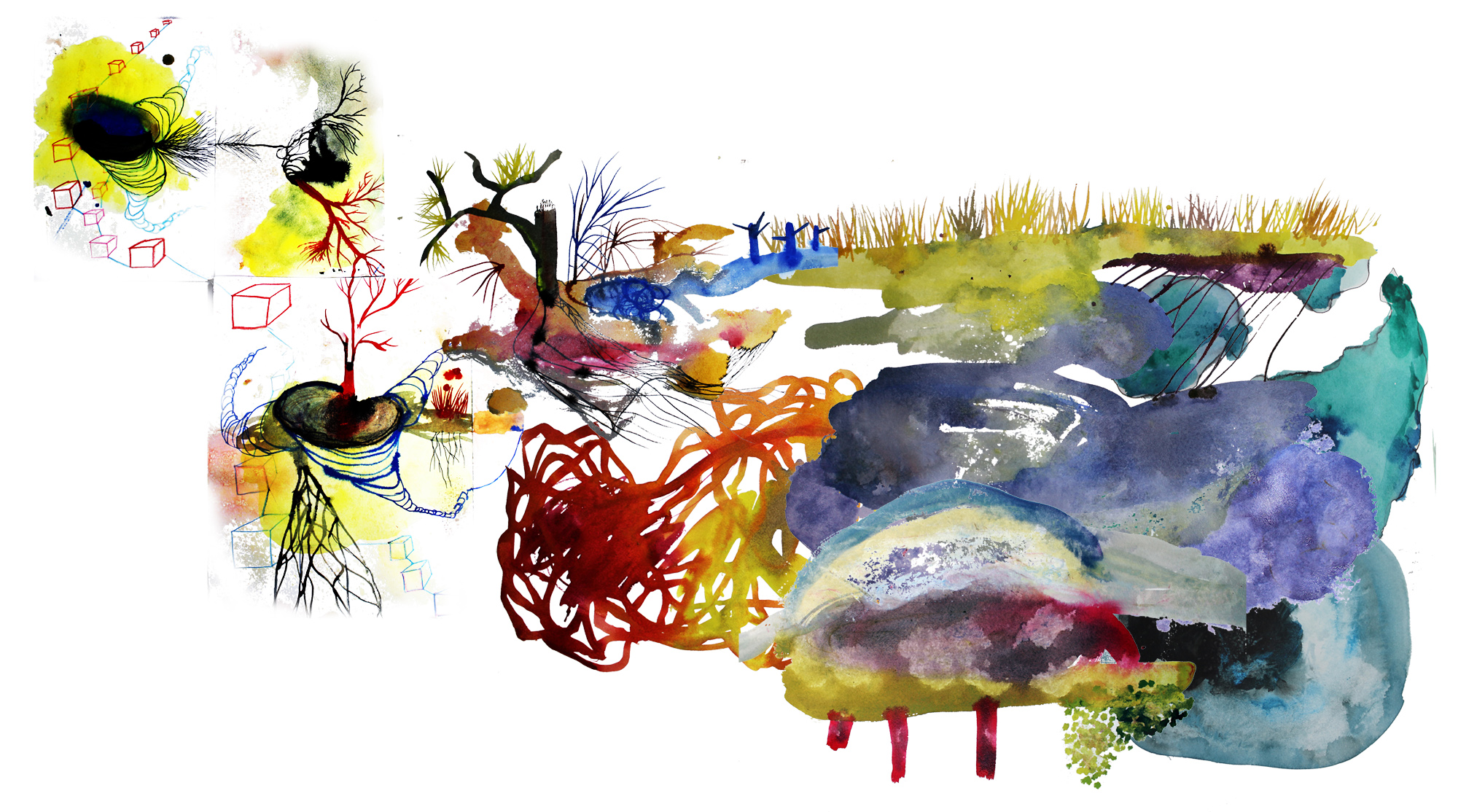
Biophilia, a Watercolor and Ink Painting by Falon Mihalic
A year ago, I read E.O. Wilson's Biophilia cover to cover for the first time. I previously read excerpts in both undergrad and graduate school, but not the book in its entirety. It's a very quick read. Perhaps its brevity is a testament to its power because the theories in this slim book were a major influence on science, anthropology, and landscape studies. The theory of Biophilia is that humans are genetically predisposed to have an affinity for living things and that we have a deep evolutionary need to be connected to the natural world. With this premise as my starting point, I dived deeper into researching our experience of the natural world based on specific areas of interest in biophilic phenomenology, plant ecology, and nature memoir. It has been a fulfilling year to go deep into researching these topics and the connection to my work as a landscape architect and public artist. Connecting people to the natural world is ultimately what my work is about. I created this readling list to share with others who may also want to explore these topics in depth.
Designer's Sketchbook: Courtyard Studies
I carry my sketchbook with me everywhere. It helps me quickly jot down visual ideas about design and I find that I learn and remember better from something I've drawn myself instead of from a photo. Lately, I have been sketching small courtyards around Houston and taking notes on how the spaces are organized and how the container plants or small in-ground plants grow within the space. These quick drawings help me learn what works and what could be done better in small urban gardens at homes, businesses, and restaurants. The best courtyard gardens feel intimate, like secret gardens, and also inviting. The trick is to use the vertical surfaces in a smart and efficient way so that the space is private and quiet. Here is a selection of recent courtyard drawings from my sketchbook:
Drawing in the Dunes published in Ground Up Journal

My essay, Drawing in the Dunes, is now published in UC Berkeley's Ground Up Journal produced by the Department of Landscape Architecture and Environmental Planning.
Big News: We won a Permanent Public Art Commission

Falon Mihalic and collaborator Graham Coreil-Allen won the Baltimore Central Avenue Percent for Art Commission to create a permanent work of public art.
Vines for Houston

Houston is a great city for growing vines. We have courtyard walls and residential fences that are spilling over with Bougainvillea, Creeping Fig, and Passion Flower. Every spring, the walls of Jasmine perfume entire neighborhoods with their sweet white star-shaped flowers. Vines are very useful for bringing lush texture to small spaces and spaces with tight corners and vertical surfaces. Some of the most commonly used vines here include Confederate Jasmine, Creeping Fig, and Bougainvillea. There are dozens of other species that are easy to care for and bring unique flowers and textures to the garden. Here are some of my favorites for their colorful flowers, all in the red-pink-purple tones, with links to more information and photos of the flowers:
Native Plant Communities of Southern Coastal Texas
Last summer, I traveled to a remote and wide open landscape of the far south southern coastal Texas range along the border between the US and Mexico: the Rio Grande Valley. The landscape there was unlike any I've experienced before and yet pieces of it felt so familiar: the white sand of the salt flats and gorgeous grasslands flowing under the Acacia trees.
Design Process: The First Site Visit

Visiting a new site for a design or public art project is one of my favorite things about being a landscape architect/public artist. The site visit tells me things that I couldn't otherwise discern from a map, a photo, or an aerial view.
Design Process: at the drawing board

I have an old-school drafting table and I use it everyday. Drawing by hand is always the very first thing that I do when starting a design project. It's how I capture site notes, develop ideas and quickly sketch and create diagrams. These initial rough sketches are developed into an overall site plan. As a Landscape Architect and Artist, drawing is a primary tool in my creative process. Here I give a sample of some of my hand drawn sketches to give you a look at my behind the scenes process of drawing.
Nature Journal: the liveliness of a single tree

There is an old live oak tree, Quercus virginiana, growing outside of my studio. Miraculously, it grows in a narrow space and hosts an amazing diversity of birds. Its trunk diameter is 12 feet with a canopy spread of 50 or more feet. Its flaring trunk base has popped the sidewalk up on one side and self-truncates at the curb. It grows in a public right of way that's only 15 feet wide between street and sidewalk. 'm lucky to see the animals that live in and visit this tree each day and I'm sharing some of my favorite moments with you on the blog as the first in my "nature journal" series.
Landscape Design Process: A guide for Homeowners
Our work, as landscape architects, is primarily accomplished through creating scaled drawings. Falon Land Studio offers sets of services that are customized to each client and project. You decide which design phases and services you need. The primary design drawing for residential landscapes is the Site Plan. Additional drawings might include a separate planting plan, construction details, elevations of site walls, paving layouts and more. The most common phases of landscape design for the residential landscape are included here.
Plant Palette: 3 tough native beauties
Houston's soil is mucky, silty, and full of clay that's nutrient dense, but typically has poor drainage. I approach landscape design for residential gardens in Houston by selecting plants that thrive in the native soil and in the rain extremes. In 2004, Houston received 12 inches of rain in one day. Not long after, our city had a drought year with only 14 inches of rain in 12 months.
To help you choose plants for our wonderfully hot and humid climate, I am creating these short plant palettes to showcase groups of plants that work well together in the garden. This first palette of three sun-loving flowering plants are all native and tolerate clay soil, high humidity, and drought.
One grain at a time: How Gulf Coast Barrier Islands Rebuild after storms
Formed by Wind. Land that is formed by wind is called aeolian after the greek god of wind, Aeolous. It's a beautiful word for a landscape process that sculpts sand into fantastic forms, pronounced 'ae-ohh-lee-an'. In Greek mythology, Aeolus lives in the stratosphere pursing his lips and directing his exhales downward at people, animals, land. The drawings of the mythical Aeolus are comical, yet the hurricane experience is otherworldly, directional like Aeolus is depicted with his massively powerful lungs gusting, huffing, and billowing. Satellite imagery shows us that hurricanes are well-organized systems of clouds and air masses and not a mythical source of wrath from the sky. But, I can say from experience that Hurricanes feel mythically powerful when you watch trees crash down on houses, roof shingles peel off, and water rise over an entire island and pull it back, wiped clean.